

Business Process Management (BPM): Definition, Steps and Benefits for Your Business in 2026
Business Process Management (BPM) is a structured approach to identifying, modeling, analyzing, improving and automating your business processes. Through a 6-step lifecycle, BPM enables organizations to reduce errors by 40 to 75% (Quixy, 2026) and achieve an average ROI of 240% (LLCBuddy, 2026). What’s changing in 2026: no-code platforms are making this discipline accessible to SMEs and mid-market companies without requiring a dedicated development team. BPM is no longer an IT project reserved for large enterprises—it’s an operational decision that any business leader can initiate today.
For a complete introduction to Business Process Management, you’ll find the fundamentals that complement this article.
Table of Contents
- What is Business Process Management (BPM)?
- Why implement a BPM strategy in 2026?
- The 6 steps of the BPM lifecycle
- Types of BPM: which approach for your business?
- Comparison table: BPM, Workflow, ERP, RPA and Automation
- How to choose the right BPM solution for your organization
- Frequently Asked Questions (FAQ) about BPM
What is Business Process Management (BPM)?
Business Process Management is the discipline of managing business processes as strategic assets of the organization, making them visible, measurable and continuously improvable.
Definition and fundamental principles of BPM
According to Wikipedia, BPM refers to the set of methods and tools that enable organizations to model, execute, monitor and optimize their processes. The core idea: a business process—from order validation to employee onboarding—should not remain in people’s heads or spreadsheets. It must be formalized, documented and managed.
BPM is built on three principles: visibility (every step of a process is mapped), traceability (every action is recorded) and continuous improvement (metrics help identify bottlenecks and enable iteration).
How does BPM differ from task and project management?
Task management handles isolated, one-off activities tied to an individual. Project management oversees a single deliverable with a defined end date. BPM, on the other hand, applies to recurring, cross-functional processes: it focuses on what repeats every day in the organization, involves multiple teams, and must operate reliably at scale. This systemic and iterative dimension is what sets BPM apart from other management approaches.
BPM vs other approaches: workflow, ERP, RPA and automation
Workflow is a subset of BPM: it describes the sequence of steps in a process, but without the dimensions of analysis, measurement and continuous optimization. ERP (Enterprise Resource Planning) centralizes business data but doesn’t manage processes as such. RPA (Robotic Process Automation) automates specific repetitive tasks without an end-to-end vision. BPM encompasses these approaches: it defines the logic, rules and objectives, then relies on workflow, RPA or application integration to implement them.
Why implement a BPM strategy in 2026?
Adopting BPM in 2026 responds to real economic pressure: organizations that manage their processes in a structured way achieve measurable gains in costs, quality and adaptability.
Cost reduction and productivity improvement
According to data compiled by BOC Group (2026), a BPM implementation reduces operating costs by 10 to 25%. At the same time, team productivity gains reach 15 to 20% according to RiseUp Labs (2026). These results are explained by the elimination of redundant tasks, the reduction of manual validations and the streamlining of handoffs between departments.
Error reduction and enhanced compliance
Manual processes generate errors by nature: duplicate data entry, missed validations, outdated document versions. BPM automation reduces these errors by 40 to 75% (Quixy, 2026). From a regulatory standpoint, a formalized and traceable process facilitates audits: every decision is timestamped, every actor identified. For organizations subject to compliance constraints—financial services, healthcare, manufacturing—this is a decisive argument.
Better visibility and process control
Without BPM, processes live in individual practices, emails and shared files. Management has no consolidated view of actual timelines, bottlenecks or team workload. With a BPM platform, real-time dashboards allow you to immediately detect a bottleneck and make decisions. This is the shift from flying blind to data-driven management.
Accelerating digital transformation
The global BPM market was worth $20.38 billion in 2024 and is expected to reach $61.17 billion by 2030 (CAGR of 20.3%), according to CFlow Apps (2026). This growth reflects a reality: digital transformation starts with formalizing processes. Automating a poorly defined process just accelerates the chaos. BPM provides the foundation on which digital projects—CRM, ERP, AI—can build.
The 6 steps of the BPM lifecycle
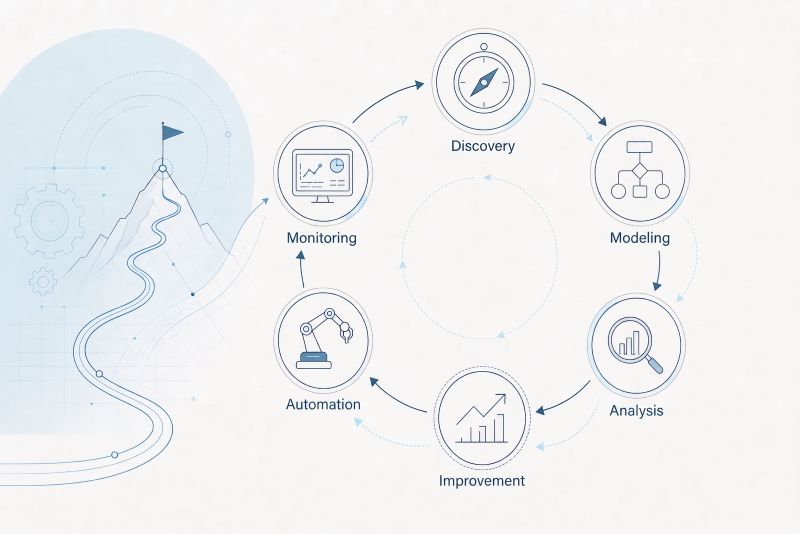
The BPM lifecycle is an iterative 6-step framework designed to improve processes continuously rather than through one-off projects.
Step 1: Discovery and mapping of existing processes
Before improving, you must understand. The discovery phase involves identifying existing processes through interviews, on-site observation and analysis of available data. The goal is to have a complete view of what actually happens—not what’s supposed to happen according to written procedures. To dive deeper into process mapping and modeling methods, specialized tools help avoid common mistakes at this stage.
Step 2: Modeling with the BPMN standard
Modeling translates discovered processes into standardized diagrams. BPMN (Business Process Model and Notation), maintained by the Workflow Management Coalition (WfMC), is the international standard for visually representing workflows. It enables all stakeholders—business teams, IT, management—to read and validate a process from the same graphical reference, without ambiguity.
Step 3: Analysis of bottlenecks and inefficiencies
Once processes are modeled, analysis measures the gaps between actual and target performance. Lean and Six Sigma methods are regularly used at this stage to identify sources of variability and waste. Key metrics include average processing time, error rate, rework rate and workload per team member.
Step 4: Process improvement and redesign
Analysis leads to concrete recommendations: eliminate an unnecessary step, merge two validations, clarify decision rules. Redesign can be incremental (marginal improvement of the existing process) or radical (complete overhaul). Best practices favor an incremental approach, which limits the risk of operational disruption while delivering visible gains quickly.
Step 5: Workflow automation
This is where the redesigned process is deployed in a BPM platform. Repetitive tasks are automated, forms generated, notifications sent, routing rules applied without human intervention. On a no-code platform, this deployability doesn’t require development skills: business leaders configure workflows themselves through visual interfaces.
Step 6: Continuous monitoring and optimization
The cycle doesn’t end at deployment. Dashboards continuously measure the performance of the automated process, detect new anomalies and feed the next improvement cycle. This iterative loop is what distinguishes BPM from a one-shot automation project: optimization is structurally built into the approach.
Types of BPM: which approach for your business?
There are three main families of BPM, defined by the nature of the processes to be managed. Identifying your profile helps you choose the configuration and priority features of your platform.
Human-centric BPM: processes involving approvals and decisions
This type of BPM applies to processes where humans remain central: quote approval, budget authorization, contract review. The platform orchestrates human interventions—who must act, within what timeframe, with what information—and automates reminders and escalations. This is the most common use case in SMEs and mid-market companies, as it covers virtually all internal management processes.
Integration-centric BPM: connecting applications and systems
When a process involves exchanging data between multiple applications (CRM, ERP, accounting tools), integration-centric BPM orchestrates these flows without human intervention. It relies on API connectors to trigger actions in third-party systems based on process events. This type of BPM overlaps with RPA for data synchronization tasks.
Document-centric BPM: form and approval management
In processes that revolve around a document—RFP, HR file, quality procedure—document-centric BPM manages the file lifecycle: creation, circulation, annotations, versions, final approval and archiving. It’s particularly used in regulated industries where document traceability is a requirement.
Comparison table: BPM, Workflow, ERP, RPA and Automation
This table summarizes the differences in scope and objective between the main process management approaches.
| Approach | Scope | Primary objective | User profile |
|---|---|---|---|
| BPM | End-to-end processes | Continuous optimization | Operations director, business manager |
| Workflow | Sequence of steps | Task orchestration | Project manager, coordinator |
| ERP | Data and resources | Information centralization | CIO, CFO |
| RPA | Single repetitive task | Targeted automation | IT teams, operations |
| Automation | Variable | Reduction of manual actions | All profiles |
How to choose the right BPM solution for your organization
Choosing a BPM solution isn’t just about comparing features: it starts with an honest assessment of your process maturity and operational priorities.
Assess the maturity of your current processes
An organization with no process mapping isn’t ready to deploy complex automation. The first question is simple: for each key process, do you know who does what, within what timeframe, and what decision to make in case of exception? If the answer is no, start with modeling. The BPM platform comes to consolidate and automate understood processes, not document chaos.
Define your objectives: costs, timelines, compliance
The three levers of a BPM project are cost reduction, timeline reduction and compliance strengthening. They don’t require the same configurations or the same priority level. An organization subject to regular audits will prioritize traceability. A sales team will first seek to reduce quote processing time. Defining these priorities upfront prevents deploying an oversized or misconfigured solution. According to Quixy (2026), 60% of organizations recover their BPM investment within the first 12 months when objectives are clearly defined from the start.
Prefer a no-code approach accessible without technical skills
This is the structural change in 2026: no-code BPM puts configuration power in the hands of business teams. Gone is the classic cycle where an operations manager writes a specification, waits 6 months for IT to develop a workflow, then discovers the result doesn’t match reality on the ground.
With a no-code platform like MAGIC BPM, an HR manager designs the onboarding form themselves, sets validation rules and deploys the process in days. No code, no dependency on a technical team. This doesn’t mean the platform is less powerful: rule engines, API connectors and dashboards remain available, but behind a visual interface anyone can use.
For SMEs and mid-market companies especially, this is a decisive advantage: BPM for SMEs now represents an immediate opportunity, not a multi-year project reserved for large enterprises with a large IT department. To learn more about available features, discover What is a BPMS platform? and the capabilities of a modern BPM management system.
Frequently Asked Questions (FAQ) about BPM
What is Business Process Management (BPM)?
Business Process Management is a management discipline that treats business processes as assets in their own right: they are mapped, measured, improved and continuously automated. Unlike project management, BPM applies to recurring, cross-functional processes that structure an organization’s daily operations.
What is the BPMN standard?
BPMN (Business Process Model and Notation) is the international standard for modeling business processes, developed and maintained by the Workflow Management Coalition. It defines a set of universal graphical symbols (events, activities, gateways, flows) that allow any process to be represented in a way that’s readable by both business and technical teams.
What is the typical ROI of a BPM implementation?
The average ROI of a BPM project is 240% (LLCBuddy, 2026), and 60% of organizations recover their investment within the first 12 months (Quixy, 2026). These results are primarily driven by reduced operating costs (10 to 25%), decreased errors (40 to 75%) and team productivity gains (15 to 20%). Actual ROI depends on the scope of automated processes and the clarity of objectives defined upfront.
How does a no-code BPM platform work?
A no-code BPM platform allows business teams to model, automate and manage processes through a visual interface, without writing code. Users draw their workflow by drag-and-drop, configure validation rules and notifications, connect forms to existing systems, then deploy the process directly. Real-time monitoring is built in: managers track the status of each process instance from a centralized dashboard.
Who needs BPM: SMEs, mid-market or large enterprises?
BPM applies to any organization that manages recurring processes—which concerns all company sizes. Large organizations were historically the first to adopt it, due to the complexity and cost of traditional solutions. No-code platforms have changed the game: SMEs and mid-market companies now have access to the same automation and management capabilities, without infrastructure investment or internal technical skills.
How do I start a BPM implementation in my organization?
Start by identifying a high-impact, well-defined process: onboarding, leave management, quote processing. Map it as it exists today, measure its friction points, then model the improved version. On a no-code platform, the move to automation takes days. Once this first process is deployed and measured, gradually extend the approach to other organizational processes.

