
What is BPMS? (Definition & Basics)
A BPMS (Business Process Management System) is a software platform that allows businesses to model, execute, monitor, and optimize their operational processes. At its core, a BPMS solution automates repetitive tasks, enforces consistent workflows, and provides visibility into how work flows through your organization.
How Business Process Management Software Works
A BPMS operates through a continuous cycle: Design → Deploy → Execute → Monitor → Optimize
When you implement a BPMS solution, you:
- Map your processes visually using process modeling tools
- Automate decision-making with rules engines and conditional logic
- Route work automatically to the right people at the right time
- Track progress in real-time with process monitoring dashboards
- Analyze performance to identify bottlenecks and improvement opportunities
Magic BPM, for example, integrates with your existing Enterprise Application Infrastructure through Enterprise Application Integration (EAI) capabilities, allowing your BPMS to communicate seamlessly with legacy systems, databases, and cloud applications. This means your business process management software doesn’t replace your current tech stack—it orchestrates it.
Key Components of a BPMS Solution
Every comprehensive BPMS includes:
- Process Designer: Visual tools to model workflows without coding
- Workflow Engine: Executes processes automatically based on defined rules
- Task Management: Assigns work items to users or systems
- Monitoring & Analytics: Real-time dashboards showing process health
- Integration Layer: Connects to ERP, CRM, and other business applications
- User Portal: Interface for workers to manage their assigned tasks
Business Process Management Solution – also called Enterprise Application Integration – helps companies’ workflow to be more efficient and effective.
Business process management system – BPMS – is a software designed to help organizations automate, optimize, and manage complex business workflows. Unlike traditional process management, BPMS software enables teams to reduce errors, improve efficiency, and scale operations without manual intervention.
It accomplishes any organizational goal in order to achieve any task in your company
Your workflows are concentrated into a unique process map you’ve deployed with Magic
Why Businesses Use BPMS Software
Business processes designed through a Business Process Management Solution reduce miscommunication as well as human errors or memory lapse.
As a consequence, it generates competitive advantages for companies using BPM Solutions, even more so the case with the facility to implement Magic itself.
Organizations across industries—manufacturing, finance, healthcare, insurance, and government—rely on BPMS solutions to drive operational excellence. Here’s why:
Reduce Errors and Miscommunication
Manual processes are error-prone. When work depends on email chains, spreadsheets, and informal handoffs, critical steps get missed, approvals get lost, and deadlines slip. A BPMS solution eliminates this by:
- Enforcing consistent workflows that everyone follows
- Automatically validating data at each step
- Creating an audit trail for compliance and troubleshooting
- Reducing miscommunication between teams through clear process visibility
As process optimization expert Clay Richardson from Forrester notes, “Process is the backbone of any organization. Without visibility into your processes, you’re flying blind.”
Automate Repetitive Workflows
Your team shouldn’t spend hours on repetitive, low-value tasks. A BPMS solution automates:
By removing manual drudgery, your team has more time for strategic work. Employees stay engaged because they’re not stuck doing the same repetitive tasks every day.
- Document routing and approvals
- Data entry and form processing
- Invoice processing and payment workflows
- Customer onboarding and request handling
- Performance monitoring and escalations
Gain Real-Time Process Visibility
Unlike traditional process management, where visibility is limited to status meetings and reports, a BPMS provides real-time dashboards showing:
- Which processes are running and where
- How long each step takes
- Where bottlenecks occur
- Which teams are meeting SLAs and which aren’t
- Predictive analytics on process performance
This visibility lets managers identify problems immediately rather than discovering them weeks later in a monthly report. As industry analyst Jelani Harper from Gartner explains, “Organizations that implement process visibility see 25-40% improvements in efficiency metrics within the first year.”
BPMS vs Traditional Process Management
Key Differences and Advantages
| Aspect | Traditional Process Management | BPMS Solution |
|---|---|---|
| Execution | Manual with checklists | Automated with rules engine |
| Visibility | Periodic reports | Real-time dashboards |
| Scalability | Requires hiring more staff | Handles volume without headcount |
| Integration | Manual data entry between systems | Automatic data flow via APIs |
| Compliance | Paper trails and documents | Built-in audit logs and version control |
| Speed | Days or weeks to process | Hours or minutes |
A BPMS software solution essentially automates what your team currently does manually—but faster, more consistently, and with full visibility.
When to Implement BPMS in Your Organization
You should consider implementing a BPMS solution if your organization:
- Processes high volumes of similar work (orders, applications, claims, approvals)
- Has multiple handoffs between teams or departments
- Struggles with missed deadlines or SLA compliance
- Relies on manual data entry between systems
- Needs audit trails and regulatory compliance documentation
- Wants to reduce operational costs while improving quality
If any of these describe your organization, a BPMS is likely a strong investment.
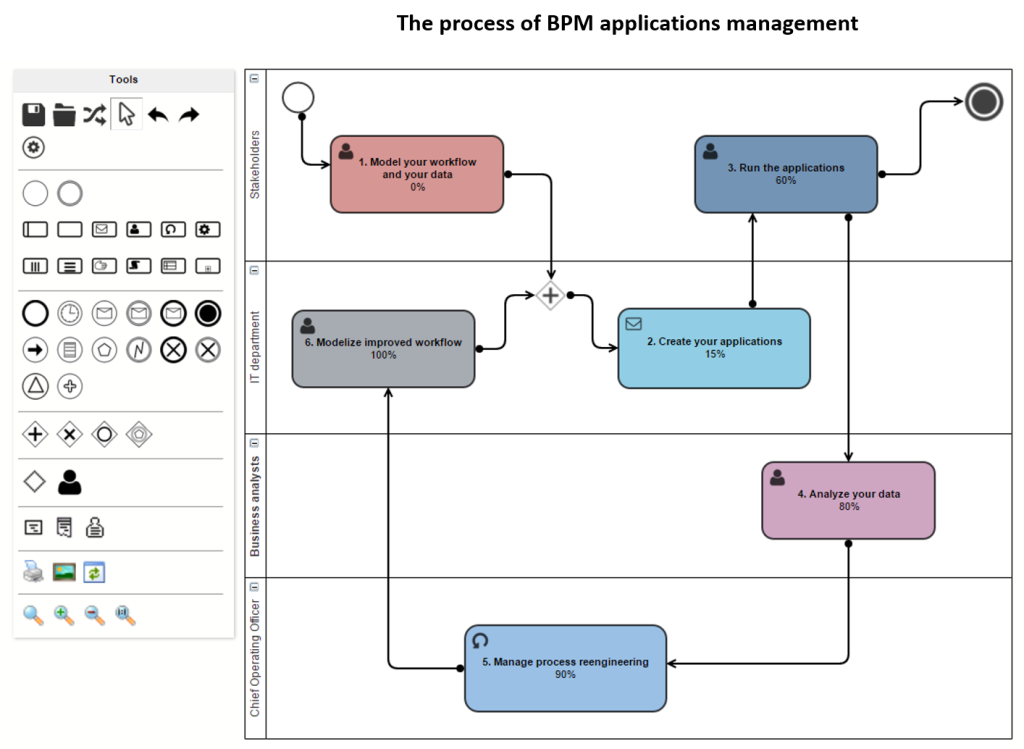
BPM’s role is to drive better experiences, greater convenience, ease of interaction.
Clay Richardson (www.bpmtips.com)
Automation makes big data initiatives much more affordable and accessible to the enterprise. Automated data science has not obscured the jobs of data scientists, but instead freed them from some of the more time-consuming aspects of their position so they can work on more profound problems.
Jelani Harper (www.bpm.com)
If senior management does not perceive how business process management (BPM) helps them get their work done and meet their performance goals, they will see little point in funding and supporting it. An inability to define the business value of your BPM program leads to the program being cut.
Gartner(www.gartner.com)

