

How can we assess the true cost and complexity of a SaaS BPM solution in 2026?
The cost of a SaaS BPM solution goes far beyond just the monthly subscription fee. When you factor in configuration, integrations, training, and maintenance, the total cost of ownership (TCO) can be 1.5 to 3 times the subscription fee in the first year alone. This complexity isn’t inevitable: a structured evaluation process and a solution tailored to your needs can significantly reduce it. The sections below detail each component of the TCO, the complexity factors to anticipate, and a four-step method for accurately estimating the cost of your BPM project—before signing any contract.
What is the TCO of a SaaS BPM solution?
The TCO (Total Cost of Ownership) of a SaaS BPM solution is the sum of all costs incurred over the project’s lifecycle, not just the subscription fee listed on the pricing page. This distinction is fundamental: two solutions with the same monthly price can result in radically different TCOs depending on the complexity of their implementation.
Beyond the Monthly Subscription
The license is just the tip of the iceberg. According to logiciels.pro (2026), the average cost of a BPM SaaS subscription is 65.69 euros per month. This figure, while seemingly attractive, does not reflect the actual expenses involved in an operational deployment. The initial configuration of workflows, the setup of business rules, integration with existing tools, and team training are all separate budget items that add up even before the solution goes live.
The Overlooked Components of TCO
A comprehensive BPM TCO includes five major cost categories. The license (monthly or annual subscription) forms the foundation. Implementation costs cover configuration, setup, and custom development. Integrations with existing systems (ERP, CRM, HRIS) are often the most underestimated cost item. User training and change management are frequently overlooked in initial budgets. Finally, ongoing maintenance ensures the solution’s long-term viability. Divalto emphasizes that the TCO methodology is specifically designed to make these costs visible as early as the scoping phase.
Why TCO Matters More Than the List Price
A BPM solution with a license that costs half as much may end up being more expensive over three years if it requires more custom development, complex integration, or significant consulting support. Comparing offerings based solely on the listed price leads to ill-informed decisions. This is particularly true in the French SME/mid-market sector, where internal technical resources are limited and every hour of external service impacts the project’s profitability.
How are the costs of a 3-year BPM project broken down?
Organizing costs in a table helps to objectively assess budget trade-offs and avoid surprises during the project. The typical three-year breakdown highlights the relative weight of services compared to the license.
Cost Breakdown Over 3 Years
For a mid-market BPM deployment, the typical breakdown over three years is as follows:
| Component | Year 1 | Grades 2–3 |
|---|---|---|
| SaaS License | Base 100 | Base 100 |
| Setup and Advice | 50 to 200 percent of the license fee | Reduced (changes) |
| Technical Integrations | 30 to 80 percent of the license | Maintenance 15% |
| User Training | 20 to 40 percent of the license fee | One-time recycling |
| Scalable Maintenance | Included or 15% | 15% of the initial cost |
According to logiciels.pro (2026), configuration and consulting costs amount to 1.5 to 3 times the license price in the first year. Annual maintenance and upgrades account for 15% of the initial cost each year.
License vs. Services
In a traditional BPM project requiring custom development, the cost of services (consulting, integration, training) frequently exceeds the cost of the license over the project’s total duration. A no-code solution reverses this ratio: services focus on functional support rather than development, which automatically reduces this variable cost. For an Enterprise-level contract, heflo.com (2026) estimates the entry threshold at around $1,000 per month, with a total TCO for a mid-market deployment over 3 years of approximately $36,000 at the entry-level price—excluding ancillary services.
Variation by Project Size
A deployment on a limited scale (5 to 10 users, 2 to 3 automated processes) has a very different cost profile than a cross-functional deployment at the scale of a mid-sized company with 500 employees. Complexity increases non-linearly with the number of processes, the volume of integrations, and the diversity of user profiles. Anticipating this trajectory in the initial business case helps avoid budget revisions during the project.
What complexity factors have the greatest impact on a BPM implementation?
The complexity of a BPM implementation does not stem solely from the technology. It involves technical, human, and regulatory aspects that interact and reinforce one another if they are not addressed from the outset.
Technical Complexity and Integrations
The number and nature of integrations are the primary factors contributing to cost overruns and schedule delays. Connecting a BPM solution to an ERP, a CRM, a document management system, or an electronic signature tool requires custom development, the scope of which varies depending on the quality of the available APIs, the recency of the target systems, and the security constraints of the infrastructure. According to cflowapps.com (2026), iBPMS (intelligent BPM) solutions will be the standard by 2026 for companies requiring more than just workflow automation, illustrating the increasing functional complexity of current deployments. A no-code solution with native connectors significantly reduces this cost.
Training Initiatives and Organizational Change
Resistance to change is the most commonly underestimated factor in BPM projects. Training users on a new tool requires a measurable amount of effort, but supporting the shift in work practices is a separate undertaking—one that takes longer and is less visible in budgets. The time required to build proficiency varies greatly depending on the technical complexity of the solution: a no-code platform accessible via a browser—requiring no installation or technical training—automatically reduces this effort, whereas a solution requiring proficiency in a proprietary scripting language extends the cycle.
Compliance and Governance Challenges
In regulated industries (finance, healthcare, manufacturing), requirements for traceability, audit trails, and access control add another layer of complexity to deployment. Processes must be documented, user permissions must be finely tuned, and activity logs must be archived according to specific standards. These constraints do not disappear with the choice of SaaS—they shift to the configuration and functional validation of the selected solution.
Methodology: How to Estimate the Actual Cost of Your BPM Project?
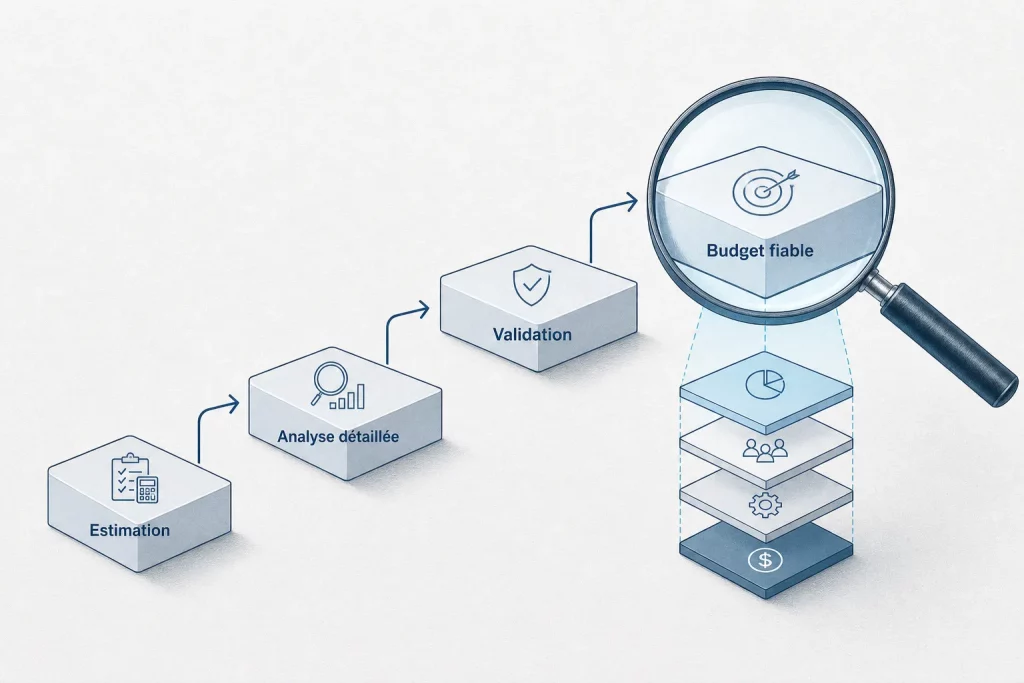
A rigorous TCO assessment follows four sequential steps that allow you to move from a rough estimate to a reliable budget. This methodology applies equally to the tool selection phase and to budget reviews during the project.
Step 1: Quantify the requirements and scope
Before comparing prices, create a detailed inventory of the processes to be automated, the number of users involved, and the priority use cases. A vague scope inevitably leads to additional costs during the project. Prioritize processes based on their business impact and technical complexity to identify a realistic—and quantifiable—scope for Phase 1.
Step 2: Budget for integrations
List each third-party system to be connected and specify the type of integration required: data reading, writing, bidirectional synchronization, or triggering actions. For each connection, evaluate whether a native connector is available in the selected solution versus the need for custom development. Native integrations directly reduce time and costs—this is one of the most critical selection criteria for a no-code BPM solution. For this reason, the TCO methodology from reussirsesprojets.com explicitly distinguishes between SaaS integration costs and on-premises costs.
Step 3: Plan for Training and Change Management
When budgeting for training, distinguish between three profiles: functional administrators (those who design processes), business managers (those who approve workflows), and end users (those who perform tasks). Each profile has distinct training needs in terms of duration and content. Also set aside a budget for change management—separate from the technical training budget—to support long-term adoption.
Step 4: Incorporate maintenance and upgrades
A BPM solution is not a one-time project but a living asset. Processes evolve along with the organization, regulations, and connected systems. Include in your 3-year TCO the annual cost of ongoing maintenance—estimated at 15% of the initial cost according to logiciels.pro (2026)—as well as the cost of version upgrades, new modules, and refresher training.
Use Cases: Expected ROI by Solution Type
The return on investment for a BPM project depends as much on the type of solution chosen as on the scope of the deployment. Two distinct profiles stand out.
No-code solution: rapid deployment, controlled TCO
A no-code BPM platform makes it possible to configure and deploy automated processes in weeks rather than months. The absence of specialized development reduces the service component of the TCO, the time to first measurable return is shorter, and business teams regain control over process evolution without technical dependencies. This approach is particularly well-suited for small and medium-sized businesses (SMBs) and mid-market companies looking to start with a targeted scope and expand gradually. The TCO over three years remains manageable because maintenance is largely handled in-house and the learning curve is short.
Traditional solution: high upfront costs, medium-term ROI
Traditional BPM solutions, which require custom development and specialized technical expertise, have an inverted cost profile: the peak investment occurs during the first 6 to 18 months. ROI only becomes apparent after this threshold, once the solution has stabilized and the teams have been trained. This model may be justified for highly complex processes or highly constrained technical environments, but it requires an initial investment capacity and a tolerance for a delayed return on investment that SMEs do not always have.
Pitfalls to Avoid When Evaluating Your BPM Solution
Assessing the TCO of a BPM solution often involves several recurring mistakes that turn well-intentioned projects into budget overruns.
Underestimating integration costs
Integrations are the aspect most frequently underestimated during the selection process. A realistic cost estimate requires consulting with technical teams from the scoping phase onward, precisely defining each required connection, and verifying the availability of native connectors in the proposed solution. A native connector with your ERP system can save you several dozen days of development time.
Forgetting about training and support
Limiting training to a get-started webinar is one of the main causes of low adoption. A BPM solution that isn’t adopted has an infinite TCO: it incurs costs without delivering results. Budget for training by user profile, designate an internal point of contact (a lead or business administrator), and schedule follow-up sessions 3 and 6 months after deployment.
Neglecting maintenance costs
It’s very tempting to include only the first year’s costs in a business case. However, ongoing maintenance—updating processes, adding new rules, and training new hires—represents a significant recurring expense. Including it from the outset in the three-year TCO provides an honest picture of the project’s true profitability.
Frequently Asked Questions About the Cost and Complexity of BPM Solutions
The average cost of a BPM SaaS subscription is 65.69 euros per month, according to logiciels.pro (2026), based on a French market analysis. This figure covers the license alone. Depending on the size of the organization and the scope of the deployment, the total price varies considerably: enterprise-level offerings far exceed this threshold, while no-code solutions available to small and medium-sized businesses often fall within this range for first-time users.
The TCO of a BPM solution is the sum of all costs associated with its acquisition, implementation, and operation over a given period (typically 3 years). It includes the license, initial configuration, technical integrations, user training, and ongoing maintenance. It is this metric—and not just the listed price—that allows for an objective comparison of two solutions.
Three factors contribute to the complexity of a BPM deployment: the breadth and depth of integrations with existing systems, the effort required for training and organizational change management, and industry-specific compliance requirements. A no-code solution significantly reduces technical complexity while retaining the rich functionality needed to automate business processes.
Training accounts for between 20 and 40 percent of the first-year license fee, depending on the solution’s complexity and the number of users to be trained. This ratio drops significantly with no-code solutions, which require no prior technical skills to get started. Annual support is generally included in the SaaS subscription for routine issues, while ongoing development falls under the maintenance budget.
The ROI of a BPM project depends on the scope of the deployment, the type of automated processes, and the time to go live. The benefits stem primarily from the reduction of low-value-added manual tasks, fewer processing errors, and faster validation cycles. A no-code solution with rapid deployment allows you to reach the break-even point sooner than a traditional solution, where the high initial investment automatically delays the ROI.
Yes, in a measurable way. A no-code BPM platform like MAGIC BPM eliminates the need for custom development to create and modify processes, reduces deployment time from several months to just a few weeks, and empowers business teams to independently evolve workflows. The TCO over three years is kept under control because the service component—the most variable and unpredictable part—is structurally lower. This is the key selling point for French small and medium-sized businesses that want to automate without having to dedicate a technical team to the task.

